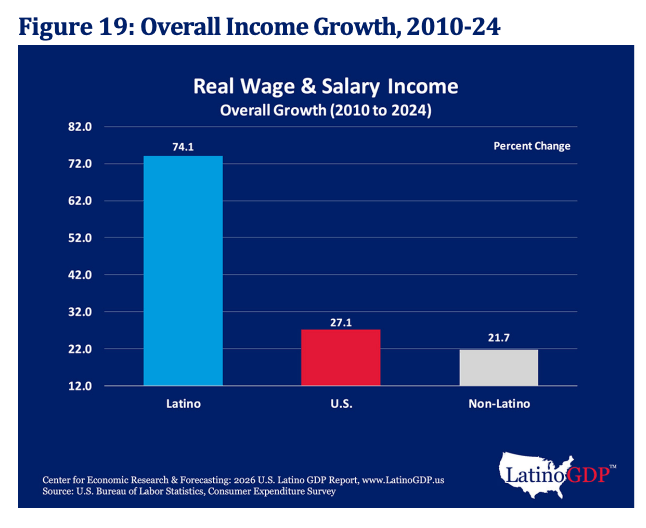
Question of the Day [Hispanic & Latine Heritage Month]: How much have wages increased for Latin(o/a) Americans since 2010?
Education and strong labor force participation have led to higher wages for Latine Americans, according to the Latino GDP report.
Answer: 74%
Questions:
- Based on what you know about education and income, do you think Latine(o/a) educational attainment increased or decreased during that time period?
- What is one way a higher income can lead to building wealth?
- What is one way government policy can affect people’s incomes?
Click here for the ready-to-go slides for this Question of the Day that you can use in your classroom.
Behind the numbers (Latino GDP Report):
"From 2010 to 2024, Latino real wage and salary income grew at an average compound annual rateFrom 2010 to 2024, Latino real wage and salary income grew at an average compound annual rateof 4 percent per year, compared to only 1.4 percent for Non-Latinos. Over that period, Latino income grew a total of 74.1 percent, while Non-Latino income grew only 21.7 percent (see Figure 19). In other words, for one and a half decades, Latino incomes have grown nearly 3.4 times faster than Non-Latino incomes...
The Latino income growth premium naturally flows from Latinos’ rapid gains in human The Latino income growth premium naturally flows from Latinos’ rapid gains in human capital. Among the strongest indicators of this are educational attainment and labor force participation data. From 2010-2024, the number of people earning a bachelor’s degree grew 3.2 times faster for Latinos than Non-Latinos. In 2024, Latinos were 6.2 percentage points more likely to be actively working or seeking work than their Non-Latino counterparts. This premium sits at an all-time high."
----------------
Celebrate Hispanic & Latine Heritage Month With Us!
----------------
About the Author
Kathryn Dawson
Kathryn (she/her) is excited to join the NGPF team after 9 years of experience in education as a mentor, tutor, and special education teacher. She is a graduate of Cornell University with a degree in policy analysis and management and has a master's degree in education from Brooklyn College. Kathryn is looking forward to bringing her passion for accessibility and educational justice into curriculum design at NGPF. During her free time, Kathryn loves embarking on cooking projects, walking around her Seattle neighborhood with her dog, or lounging in a hammock with a book.
SEARCH FOR CONTENT

Subscribe to the blog
Join the more than 11,000 teachers who get the NGPF daily blog delivered to their inbox:
MOST POPULAR POSTS
3